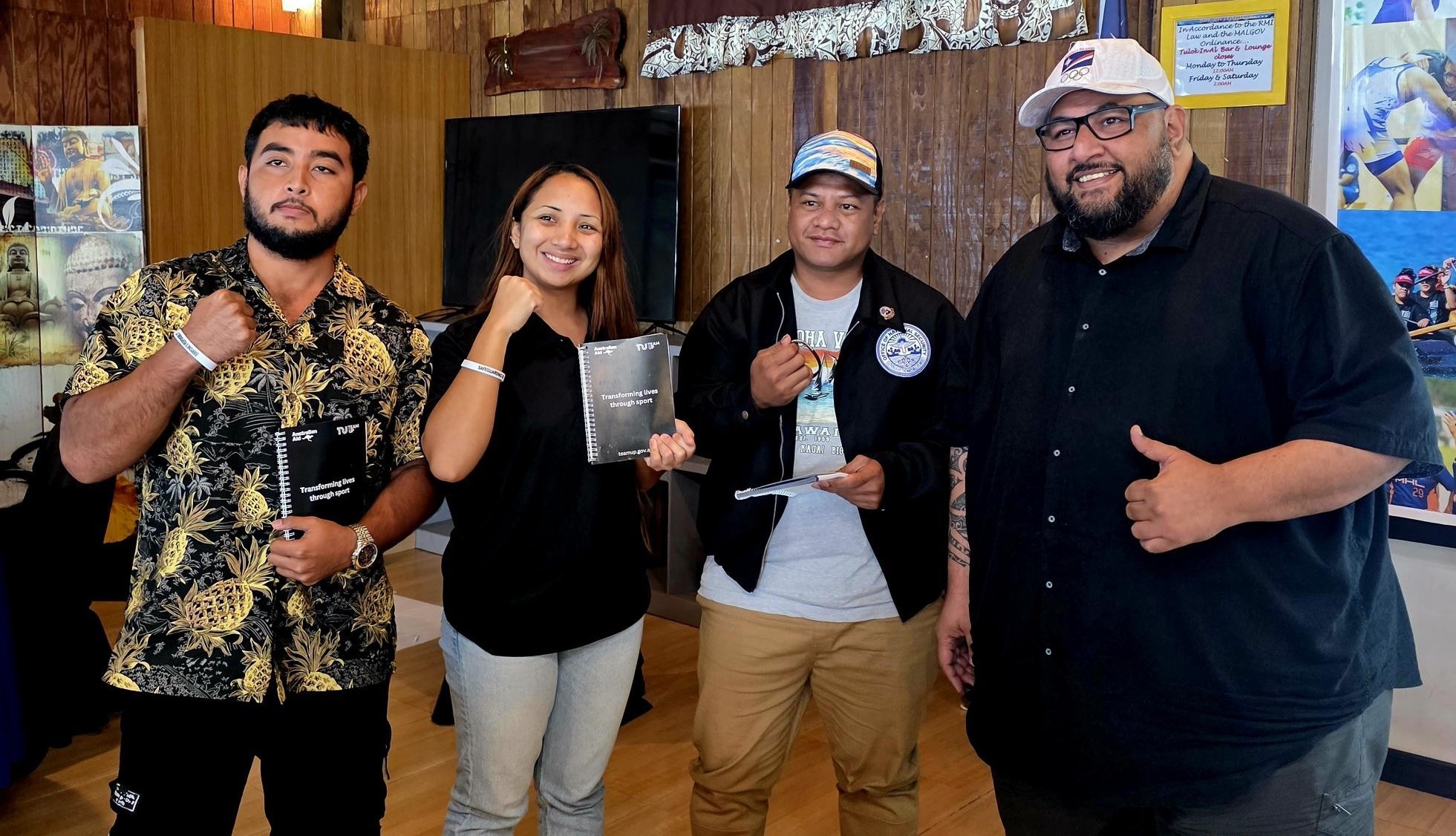


SAFEGUARDING WORKSHOP TO HELP STRENGTHEN MARSHALL ISLANDS SPORT FEDERATIONS
Empowering athletes and federations to create safe, respectful sporting spaces .
National sports organisations in the Republic of the Marshall Islands (RMI) are building stronger foundations for athlete safety through a three-day safeguarding workshop organised by the Marshall Islands National Olympic Committee (MINOC) and facilitated by Roshika Deo, Gender Equality, Disability and Social Inclusion (GEDSI) and Safeguarding Advisor from the Australian Government’s Team Up program. The training was delivered as part of technical support provided through the Oceania Impact Network, with funding support from Olympic Solidarity.
The workshop focused on creating a safer environment for athletes, strengthening systems to prevent harm and supporting National Federations to meet their responsibility to care for and protect participants.
Tatiana Shoniber, a paddler from RMI, said the workshop was highly relevant to her role as both an athlete and leader, providing practical guidance on safeguarding in sport.
“As a paddler and team captain for the women’s team this workshop was particularly relevant and practical. It helped me better understand the responsibility I have in creating a safe and respectful environment. It also helped me understand what appropriate coach behaviour and safe communication with athletes look like, and how to respond if a child raises a concern.
Recently I was appointed as the Athlete Commission (AC) Representative for paddling, and I also sit on the Marshall Islands Canoe Paddling Federation board, and after this workshop I have clearer direction on how to work with the board to implement the safeguarding component that is included in our Marshall Islands Canoe Paddling Federation bylaws. Some of the things we will be doing is establishing a clear reporting pathway for concerns and ensuring we always have proper supervision during youth paddling activities. This workshop helped me understand the importance of having a dedicated safeguarding officer," she said.
The safeguarding workshop aimed to help national sporting bodies, organisations and athletes better understand what safeguarding means in sport, recognise poor practices and identify issues such as abuse, violence and neglect. Participants also reviewed the MINOC Safeguarding Policy and took part in practical scenarios to better prepare them to receive and manage safeguarding concerns.
“The workshop was highly informative and provided a clearer understanding of safeguarding and its importance in sport. It also created a valuable platform for collaboration among sports organisations, marking a meaningful step toward aligning with the principles of the wider Olympic Movement. Through this initiative, we are strengthening a culture of care, accountability and protection across all levels of sport in the Marshall Islands,” said MINOC Executive Board Vice President Safeguarding, Damien W. Jacklick.
Roshika Deo, Team Up Gender Equality, Disability and Social Inclusion (GEDSI) and Safeguarding Advisor said the strong engagement and commitment shown by participants throughout the workshop was encouraging.
“During the workshop discussions the participants highlighted different challenges in implementing safeguarding procedures especially for smaller island nations. We worked on different case scenarios to find solutions which were aligned with the cultural context and safeguarding best practices. It was good to be in the same space and to have these discussions in person. One of the activities carried out by the national federations present was to develop their own safeguarding action plans and we look forward to seeing the safeguarding actions being implemented,” she said.
This workshop reflects a shared commitment by regional and international partners to support safer, more inclusive sport across the Pacific. Alongside RMI, National Olympic Committees in Tuvalu, Tonga and Nauru have also been supported through the partnership.
ENDS/
About MINOC: The Marshall Islands National Olympic Committee (MINOC) is a member of the Oceania National Olympic Committee (ONOC), recognised by the International Olympic Committee (IOC) in 2006. MINOC is responsible for the preparation of athletes to the Olympic Games and the Pacific Games, aiming to promote sports and combat issues like youth obesity.
About Oceania Impact Network: The Oceania Impact Network is a collective of committed stakeholders who share a common vision of promoting gender equality, inclusion, and safety in and through sports in the Pacific. It is made up of the Australian Government’s sport for development program Team Up; UN Women, through the Pacific Partnership to End Violence Against Women and Girls (Pacific Partnership) funded primarily by the Government of Australia, and the European Union; the Oceania National Olympic Committees (ONOC), through its Equity Commission; and the International Olympic Committee (IOC) through Olympism365 and Olympic Solidarity.
About Team Up: Team Up is the Australian Government’s sport for development program in the Asia-Pacific. With more than 70 partners across seven Pacific Island countries, our programs are specifically designed to provide all people, regardless of gender or ability, the opportunity to realise their full potential through sport.
Follow all the news from Team Up on the program’s website and on Facebook, Twitter, Instagram and LinkedIn.